
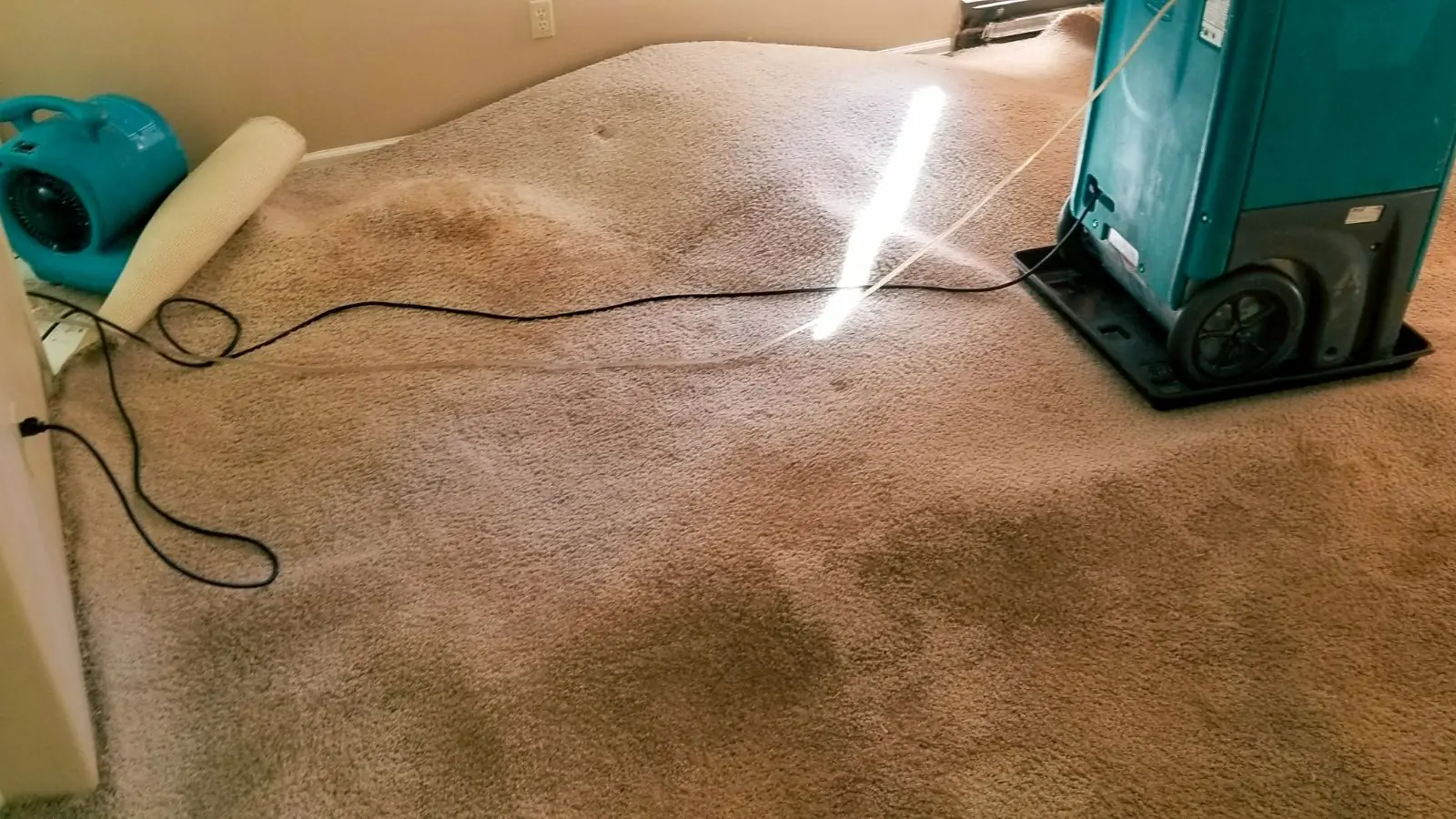
Carpet has three layers that matter after a leak: the surface fiber, the pad beneath it and the subfloor under that. Surface fiber dries quickly, but the pad holds water and is the layer that causes most problems. Call (833) 521-1033 as soon as you see a wet carpet.
Wet carpet and soggy pad
Press a dry towel on the carpet and watch whether it soaks up water. Squishing underfoot means the pad is saturated. Water that sits in the pad can wick into baseboards, and it feeds odor and mold if it stays.
Take off shoes, lift furniture onto blocks or foil, and remove small items. Do not use a household vacuum on wet carpet. Fans help move air but do not replace extraction.
Dry it or replace it
| Situation | Usual outcome | Why |
|---|---|---|
| Clean water caught quickly | Carpet dried, pad may be replaced | Fibers recover, pad holds water |
| Clean water over a day or more | Pad removed, carpet dried or replaced | Odor and growth risk rise |
| Contaminated water | Carpet and pad removed | Porous materials hold contaminants |
| Carpet over a wet slab | Lifted to dry the slab | Trapped moisture will not leave |
The decision comes from water category and time. Clean water caught early often allows drying in place. Water that is contaminated, such as sewage or floodwater, means removal, as covered on the sewage backup and flood damage pages.
How carpet is dried
A crew extracts water with a wand, lifts the carpet at the edges and removes the pad if needed. Air movers push air under the carpet and dehumidifiers pull the moisture out of the room. Meters check the subfloor before anything goes back down.
Wall edges matter, because water wicks up into baseboards and drywall. See wall and drywall repair for those, and structural drying for how readings prove the job is done.
Carpet wet through?
Call for extraction and a drying plan.
Stairs, bedrooms and wall-to-wall installs
Carpet is installed in different ways, and the layout affects how it is dried. Wall-to-wall carpet is stretched over tack strips at the edges. A crew can release a corner, fold the carpet back and dry the pad and subfloor underneath, then restretch it if it is in good condition. Area rugs are easier, and are usually taken outside or to a cleaning facility.
Stairs and bedrooms bring their own problems. Water from a leak above often runs down a stair carpet and soaks the landing below. Bedroom carpet near an exterior wall may be wet from a window leak. In each case, check the baseboard and the bottom of the wall, because water moves along the floor and up into the wall.
Odors are a sign of leftover moisture. After drying, carpet may be cleaned and deodorized, but cleaning is not a substitute for drying. If an odor remains after drying readings are normal, the pad or subfloor may need further attention. Some carpets also shrink, delaminate or release dye when wet, and a damaged backing does not recover, so replacement is more likely in those cases.
Carpet and pad decisions follow ANSI/IICRC S500, the standard that defines how wet buildings are dried, which ties the outcome to the water category and how long the material stayed wet.
Costs and insurance
Water category
Clean water and contaminated water lead to different outcomes.
Time wet
Carpet that sat for days is harder to keep.
Area
A single room and a whole level are different jobs.
Pad and subfloor
Pad replacement is common and subfloor drying adds time.
Replacement
New carpet and installation are priced separately.
Insurers may cover sudden water damage to carpet. Take photos and keep receipts. We cannot promise coverage. Call (833) 521-1033 and ask how scope and price are explained before the pad comes out.
Wet carpet calls come from New Canaan, Darien, Norwalk, Wilton and Stamford, with Westport, Weston, Greenwich, Ridgefield and Redding confirmed by phone.
Common questions
Can wet carpet be dried?
Often, when the water was clean and removed quickly. The pad usually needs more attention than the carpet.
Why does wet carpet smell?
Moisture trapped in the pad and subfloor allows odors. Removing the water and drying completely clears most of it.
How long can carpet stay wet before mold?
It depends on conditions, but a day or two is often enough for trouble to start. Act early.
Do I need to replace the pad?
Often yes, because pad is hard to dry and inexpensive compared to the problems a wet pad causes.