
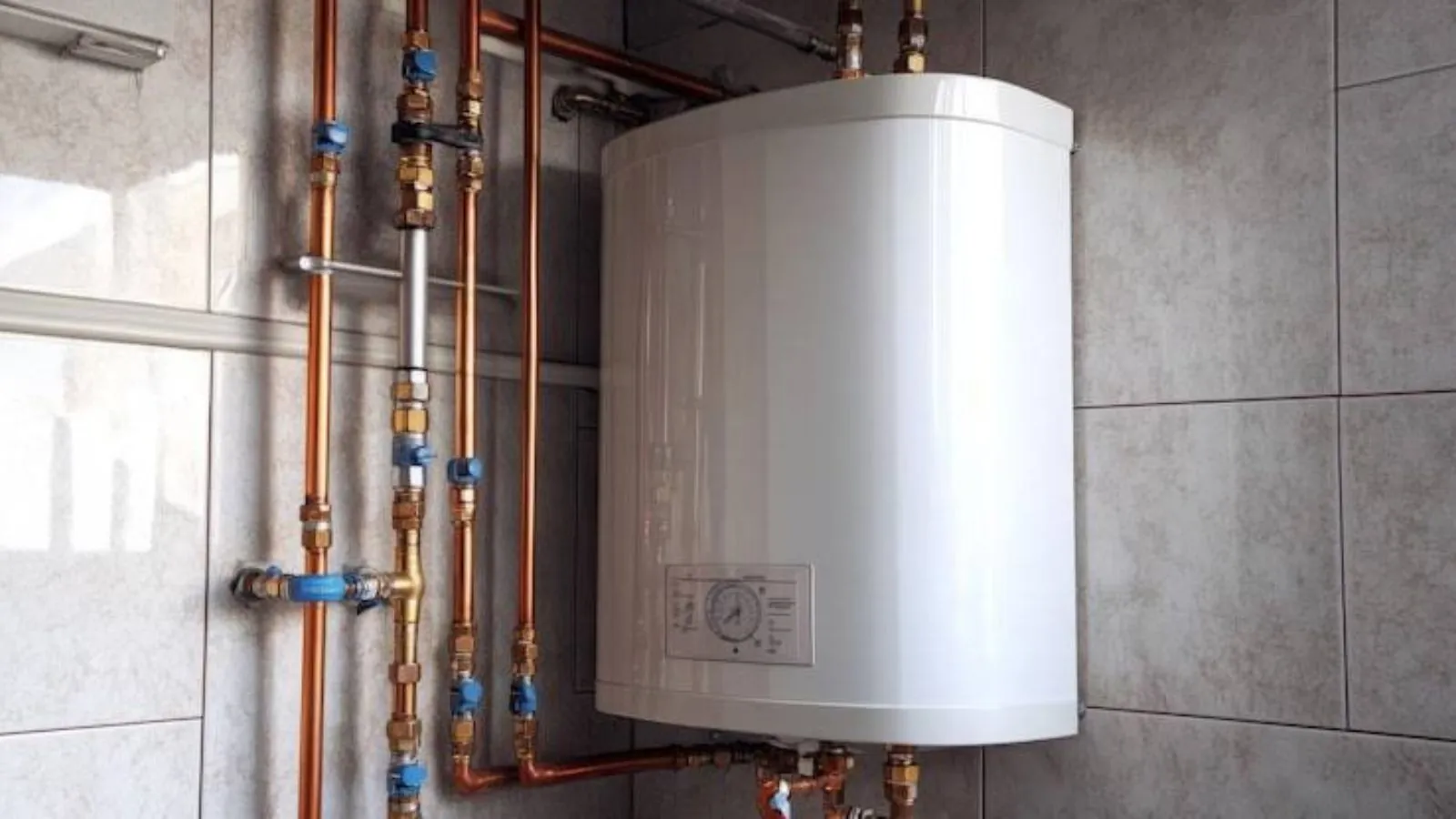
A residential tank holds dozens of gallons, and when the steel liner fails or a fitting gives way, that water has nowhere to go but the floor. Many heaters sit in a basement, a garage, a utility closet or an attic, so the water reaches finished rooms, ceilings and stored belongings quickly. If it is happening now, call (833) 521-1033 and the 24/7 line starts the response while you handle the shutoff.
Tank leaking or burst right now
Close the cold water supply valve on the pipe feeding the top of the tank. Then turn off the power at the breaker for an electric unit, or turn the gas control to pilot or off for a gas unit. If you smell gas, leave the house and call the gas utility or 911 from outside.
Do not touch the unit with wet hands, and do not stand in water near a panel. Hot water can scald, so keep children and pets away from the area. A tank that is leaking a little can often be drained through the hose bib at its base once the supply is off, which a plumber can handle.
Hot water and electricity
Water from a water heater may still be hot and may reach outlets or a panel. Stay out of standing water that touches electrical equipment, cut power only from dry ground and call the utility or 911 about live hazards.
Where heater water goes
In a basement the water spreads across the slab and soaks the base of drywall, stored boxes and any carpet. In a garage it runs toward the door or a floor drain. In an attic or a second-floor closet it drops through ceilings, which is why a heater leak can look like a ceiling leak from the floor below.
Water from a clean supply line is Category 1, and sediment inside an old tank can make it look cloudy without changing that. A crew still checks the surrounding materials, because wicking into baseboards and wall cavities is the usual surprise.
| Heater location | What gets wet | What a crew checks |
|---|---|---|
| Basement | Slab, drywall base, stored items | Wall cavities, carpet, nearby utilities |
| Garage | Floor, stored boxes, shared walls | Wall base, attached rooms, drain path |
| Utility closet | Flooring, closet walls, adjoining rooms | Subfloor, baseboards, cabinet bases |
| Attic or upper floor | Insulation, ceiling below, rooms under | Ceiling sag, insulation, framing |
Heater water on the floor?
Call dispatch for extraction and drying equipment.
Cleanup after a water heater leak
Extraction comes first, using pumps or wet vacuums depending on depth. Wet carpet pad, soaked insulation and swollen cardboard are removed. Air movers and dehumidifiers dry the area, and meters are read each day until the structure is dry.
Replacing the heater belongs to a plumber, and we do not install water heaters. We deal with the water damage. If the leak ran through to the floor below, see ceiling water damage, and for a heater in a lower level, the notes on basement water damage apply. Drying methods are explained on the structural drying page.
Why water heaters fail
Tanks corrode from the inside over time, and the anode rod that slows that corrosion wears away. Sediment builds at the base and can overheat the tank wall. Fittings and relief valves can also drip and slowly rot a floor before anyone sees them.
A damp spot, rust streaks, a puddle that returns or a hissing sound from the tank are early signs. A plumber can check the age of the unit from its label. Catching a small leak early is far less costly than the cleanup after a burst tank.
Cleanup after a tank leak follows ANSI/IICRC S500, the published guide for professional restoration work, so extraction, drying and readings are done in a set order.
Costs and insurance
Volume of water released
A slow seep and a ruptured tank produce very different jobs.
Heater location
Basements, closets and attics have different materials around them.
Rooms and materials reached
Carpet, drywall and flooring each have their own plan.
Drying days
Wet framing and slab take longer than surface water.
Rebuild scope
Trim, drywall and paint are separate from drying.
A sudden tank failure is often covered, while a leak that went on for months may be treated as gradual damage. Read your policy and call your insurer promptly. We provide photos, readings and a written scope, and we cannot promise a claim outcome. The scope and price are explained before work begins when you call (833) 521-1033.
Heater leaks across New Canaan reach us, and so do calls from Darien, Norwalk, Wilton, Stamford and Westport. Weston, Greenwich, Ridgefield and Redding addresses are confirmed by phone.
Common questions
Do you handle water heater emergencies at night or on weekends in New Canaan?
Yes. The line is answered 24/7. Call (833) 521-1033, say that the water heater is leaking and whether you could shut the supply, and a crew is arranged.
Should I drain the tank myself?
Only after the supply and power or gas are off. Attach a hose to the drain valve and run it to a floor drain or outside. If the tank is leaking from the body, a plumber should replace it.
Is a slow water heater leak still water damage?
Yes. A small leak that runs for weeks can rot flooring and feed mold. A moisture check shows how far it reached.
Will insurance pay for the water heater itself?
Policies usually treat the failed appliance as wear and tear, and may cover the resulting water damage. Ask your insurer what applies to your policy.